If you’ve recently moved to Palm Beach County from a northern state, or if you’ve owned a South Florida home for years and always wondered whether you’re maintaining your pool correctly, this guide is for you. Pool service Palm Beach County requires significantly different standards from national pool care standards – and the difference comes down to one unavoidable reality: South Florida pools are a year-round responsibility.
Unlike pools in colder climates that close for winter, Palm Beach County pools operate 12 months a year in warm, often humid conditions that accelerate chemical consumption, algae growth, and equipment wear. This guide gives you an honest, month-by-month breakdown of what your pool actually needs – and what pool service Palm Beach County looks like in practice across every season.
Palm Beach County sits at approximately 26–27° north latitude, which means:
Each of these factors directly affects how often you need pool service in Palm Beach County, and what tasks need to be performed at each visit. The national recommendation of “once a week” is the minimum baseline – not the complete picture.
The honest answer to how often clean pool Florida homeowners need: at a minimum, weekly, and more frequently during peak conditions. Here’s the practical breakdown:
This calendar reflects the conditions specific to the West Palm Beach area and broader Palm Beach County, accounting for seasonal temperature, rainfall, bather load, and biological activity patterns:
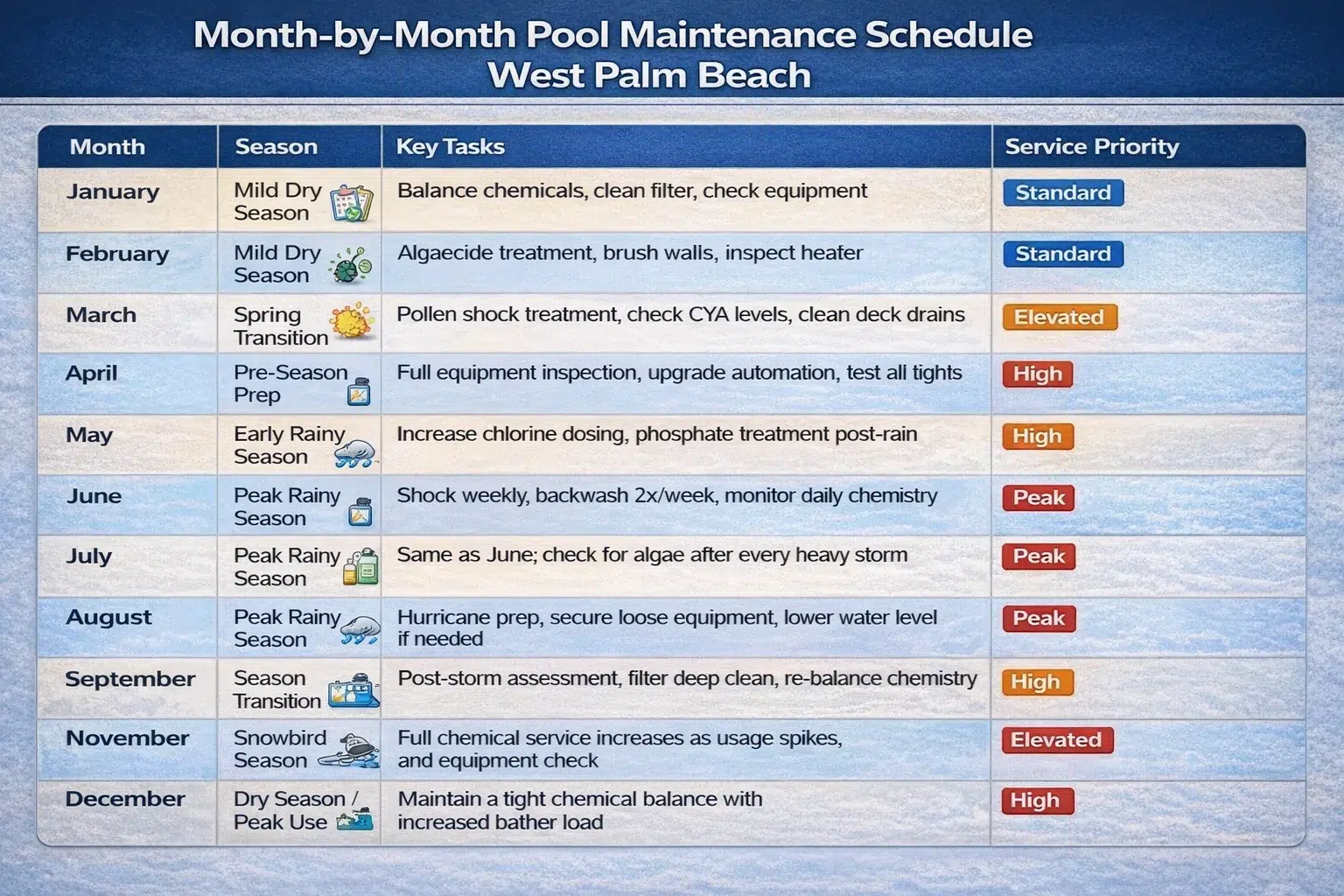
Many Palm Beach County homeowners make the mistake of reducing pool service frequency during the cooler winter months. While algae growth slows slightly and UV intensity is lower, two factors demand continued attention: the arrival of snowbird residents dramatically increases bather load, and cooler water chemistry behaves differently – pH tends to drift higher as CO₂ levels change with temperature.
Weekly pool service Jupiter FL and West Palm Beach professionals see a consistent spike in service calls in January and February related to unbalanced water in pools that were “coasting” through December. Maintain your full service schedule.
March and April are the most important months for the pool maintenance schedule that West Palm Beach homeowners often overlook. South Florida’s spring pollen season is aggressive – oak, pine, and melaleuca pollen create a significant organic load in open pools that consumes chlorine and feeds algae. Concurrently, water temperatures begin climbing toward the range where algae thrives.
This six-month window is where pool service Palm Beach County professionals earn their value. The combination of daily afternoon storms, extreme UV, high water temperatures, and peak bather loads creates conditions that can overwhelm a pool maintained to winter standards.
Step 1: Increase chlorine target: Maintain free chlorine at 3–5 ppm (not the standard 2–4 ppm) to buffer against rapid UV and storm-induced depletion
Step 2: Test after every storm: A single heavy storm can swing pH, dilute chlorine, and spike phosphate levels – all within 24 hours
Step 3: Consider liquid chlorine over tablets during peak summer: Trichlor tablets add CYA with every dose; in a pool already stressed by rain dilution and heat, CYA accumulation can cause chlorine lock
Step 4: Monitor filter pressure daily during August – peak bather loads and storm debris load filters significantly faster than other months
Step 5: Hurricane preparedness (August–October): Know your pool shutdown protocol before storm season peaks
When seasonal residents return to Palm Beach County in November, pool usage in many communities doubles or triples virtually overnight. Weekly pool service Jupiter FL and West Palm Beach providers see service volume spike significantly from mid-November onward as dormant pools are reopened and bather loads intensify.
November through December priorities:
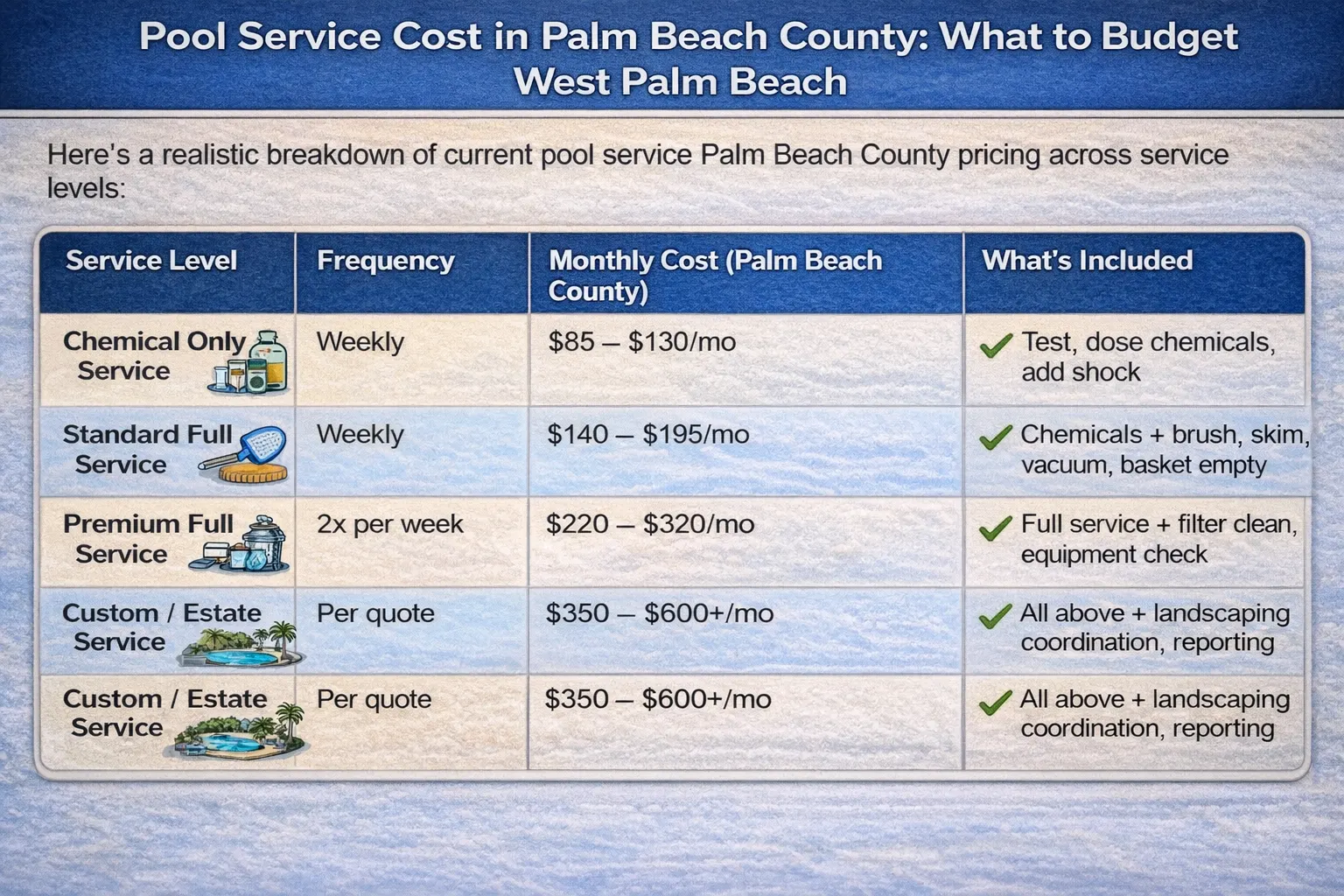
Here’s a realistic breakdown of current pool service Palm Beach County pricing across service levels:
For most year-round residents with a standard 15,000–20,000-gallon pool in West Palm Beach, Jupiter, or Boca Raton, a standard full-service weekly plan in the $140–$195/month range is the appropriate baseline. Upgrade to twice-weekly during June through September for comprehensive rainy season coverage.
When evaluating weekly pool service Jupiter, FL, or broader Palm Beach County providers:
Pool service in Palm Beach County is not a luxury expense—it’s the foundational investment that protects a $30,000–$150,000+ asset. A properly maintained pool costs less to operate each year, lasts longer before needing renovation, and stays consistently ready for use throughout South Florida’s extended swim season. Partnering with a reliable provider like Pool Service Plus ensures your pool remains efficient, well-maintained, and hassle-free year-round.
Pools in Palm Beach County should be serviced at least once a week year-round, with increased frequency (twice weekly) during the rainy season due to higher heat, rain, and chemical fluctuations.
2. Why does pool maintenance differ in South Florida?
South Florida’s year-round warm climate, high UV exposure, heavy rainfall, and increased bather load create conditions that require more frequent cleaning and chemical balancing than colder regions.
3. What is included in a standard pool service?
A standard pool service typically includes chemical testing and balancing, skimming, brushing, vacuuming, emptying baskets, and basic equipment checks to maintain water quality and safety.
4. How does the rainy season affect pool maintenance?
Rain dilutes chemicals, increases phosphates, and raises water levels, making it necessary to test water more frequently, adjust chlorine levels, and perform shock treatments after heavy storms.
5. What is the average cost of pool service in Palm Beach County?
Pool service costs typically range from $85 to $600+ per month depending on service level, frequency, and additional features like equipment checks or full-service maintenance.