You walk out to your backyard on a Wednesday afternoon in July. Your pool was clear last weekend. Now it is green.
It is one of the most frustrating moments a West Palm Beach homeowner can experience. And it happens faster here than almost anywhere else in the country.
At Pool Service Plus, our technicians handle green pool recoveries across West Palm Beach, Palm Beach Gardens, Jupiter, and Wellington every week throughout summer. Here is exactly why it happens in WPB, and the fastest, most proven way to fix it.
Green pool problems in WPB are not bad luck. They are the predictable result of specific local conditions that hit your pool at the same time:
When these factors combine and push chlorine below 1 ppm in 90°F water, algae can establish itself in 24 to 48 hours. That window opens fast in WPB summer, often after just one skipped service visit combined with a heavy storm.
Data Point: Pool Service Plus technicians report that the large majority of emergency green pool calls across Palm Beach County arrive in July and August, and nearly all involve pools where regular maintenance was delayed by just one week.
Pro Tip: In West Palm Beach summer, your pool does not need weeks of neglect to turn green. A missed service visit during a heat wave, especially following an afternoon storm that loaded phosphates into the water, is often enough.
Not every green pool has the same cause. Identifying the correct algae type before treating saves time, money, and chemical waste.
Turns water cloudy and green, from a faint tinge to full swamp color depending on severity. Floats in the water and coats walls and floors. The direct cause is chlorine dropping below safe levels, typically after a storm adds phosphates to an already borderline pool.
Treatment: super-shock the pool with calcium hypochlorite, brush all surfaces aggressively, and run the filter continuously until the water tests clear.
Appears as a yellowish-brown dusting on walls and floors. Frequently mistaken for sand or fine sediment. Particularly resistant to standard chlorine levels, making it common in WPB saltwater pools.
Treatment: a targeted mustard algaecide, vigorous brushing of every surface, and a sustained elevated-chlorine cycle over several days.
Dark blue-green spots or patches on plaster and pebble surfaces. It has a protective outer coating that resists standard chlorine. Typically introduced via swimwear or equipment that was used in another body of water.
Treatment: stiff wire brushing, a dedicated black algae killer, and sustained high-chlorine treatment. Professional remediation is usually required for complete eradication.
Pink or reddish buildup appearing around return jets, ladder rails, and light fixtures. Despite looking like algae, this is actually a bacterium. Treated with shock, a targeted pink slime product, and significantly increased pump and filter runtime.
Common Mistake: Using the wrong treatment for the wrong type is one of the most common and costly pool recovery mistakes. If you are unsure which type you are dealing with, contact Pool Service Plus before purchasing any products.
This step-by-step protocol is for standard green algae, the most common WPB scenario. Mustard and black algae require additional targeted treatments alongside these steps.
Pro Tip: A severely green pool in WPB summer typically takes 3 to 5 days to fully clear, even with aggressive treatment. Stopping treatment or turning off the pump because the water starts to look better is the single biggest recovery mistake. Algae is not dead until the water tests completely clear at correct chemistry.
Recovery time depends directly on bloom severity:
The most reliable way to minimize recovery time is to act the moment you notice anything unusual. The window between catching a problem early and a full multi-day recovery project is measured in hours in WPB’s summer heat.
Recurring green pools despite treatment almost always come down to one of three root causes:
Data Point: A pool with CYA above 80 ppm has chlorine working at only 20–30% of its stated effectiveness. This hidden condition explains many recurring algae problems in WPB pools that appear to have adequate chlorine.
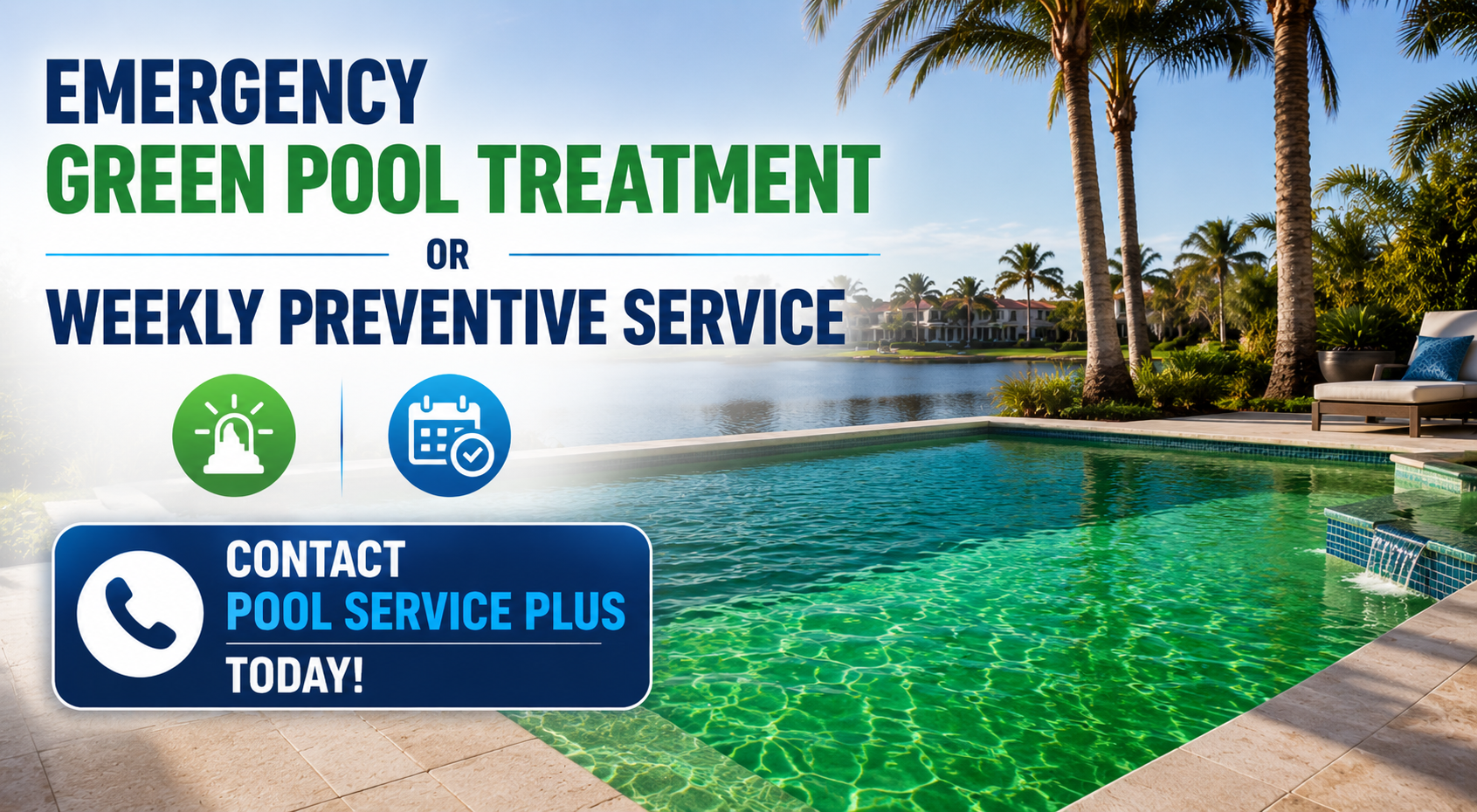
A West Palm Beach pool that turns slightly green, when caught immediately, can often be fixed in one visit. Left even a few more days in July heat, it can become a multi-day recovery project with hundreds of dollars in chemicals.
The moment you notice any change in water clarity or color, test the chemistry and take action. In Palm Beach County summer, the cost of acting fast is always far less than the cost of waiting.
Pool Service Plus provides emergency green pool remediation, regular preventive service, and professional pool water testing service across West Palm Beach, Palm Beach Gardens, Jupiter, and Wellington. Our team is ready to help.
How long does it take to fix a green pool in West Palm Beach?
A mild green pool can clear in 24–48 hours. A severe algae bloom may take 3–5 days with proper treatment, filter cleaning, and chemistry monitoring.
Is it safe to swim in a green pool?
No. A green pool means algae growth and chemical imbalance. Wait until the water is clear and chlorine and pH levels are safe before swimming.
Why did my West Palm Beach pool turn green after rain?
Rain can dilute chlorine, change pH, and add debris or phosphates. Retest and rebalance the pool within 24 hours after heavy rain.
Why does my pool keep turning green after I shock it?
Common causes include stopping treatment too early, high phosphate levels, poor filtration, or chlorine lock caused by high cyanuric acid.
Does Pool Service Plus handle emergency green pool calls?
Yes. Pool Service Plus handles emergency green pool cleanup across West Palm Beach, Palm Beach Gardens, Jupiter, Wellington, and nearby areas.